

The capstone had two separate technical tracks
GiziLens was a team capstone from the DBS Foundation program built around a simple idea: a nutrition-oriented application could begin with something users already have, a photo of food or an ingredient.
The project explored that idea through two different technical responsibilities.
One side of the team worked on food-image recognition, turning an image into one of the supported ingredient labels. The other side worked on the application around that capability: how a user enters the system, how identity and sessions are managed, where application data lives, and how the web stack can be run as a deployable service.
Those responsibilities lived in separate repositories, and they were not fully integrated into a single end-to-end production flow in the repository state preserved today. GiziLens was a team system in progress, not a finished product where every subsystem had already been connected.
flowchart LR
    IDEA[GiziLens product idea]
    IDEA --> ML[Machine-learning subsystem]
    IDEA --> APP[Web application subsystem]

    ML --> CLASSIFY[Food / ingredient classification]
    APP --> AUTH[Identity and sessions]
    APP --> DATA[Application persistence]
    APP --> RUNTIME[Deployment and runtime]
Food recognition was a team subsystem
The team's machine-learning repository contains a 32-class food and ingredient image classifier built with TensorFlow and EfficientNetV2L.
Its dataset combined several public image sources and grouped the supported labels into fruits, vegetables, nuts, and seasonings. Training used 224 × 224 images, augmentation, an ImageNet-pretrained EfficientNetV2L backbone, and a classification head for the 32 output classes.
A separate prediction script shows the inference boundary clearly: load the trained Keras model, prepare an input image, run the model, and map the highest-scoring output to an ingredient label.
This subsystem belongs to the GiziLens team project, but it was not my individual implementation. The repository history attributes the machine-learning work to another team member.
My contribution centered on the web application
Within the capstone team, my implementation work is most visible in the separate Web-App repository.
I worked on the foundation needed for GiziLens to behave like an actual web application. Users need accounts, authenticated requests need a session model, the backend needs persistence and caching, and the whole stack needs a predictable way to run outside a developer's editor.
The application repository is split into a Nuxt frontend and a Bun/TypeScript backend built with Hapi.
flowchart TB
    U[User] --> NUXT[Nuxt web application]
    NUXT --> API[Application API]

    API --> AUTH[Authentication and user flows]
    AUTH --> SESSION[JWT + session lifecycle]

    API --> PG[(PostgreSQL)]
    API --> REDIS[(Redis)]

    NUXT --> DEPLOY[Containerized runtime]
    API --> DEPLOY
    DEPLOY --> NGINX[Nginx / HTTPS boundary]
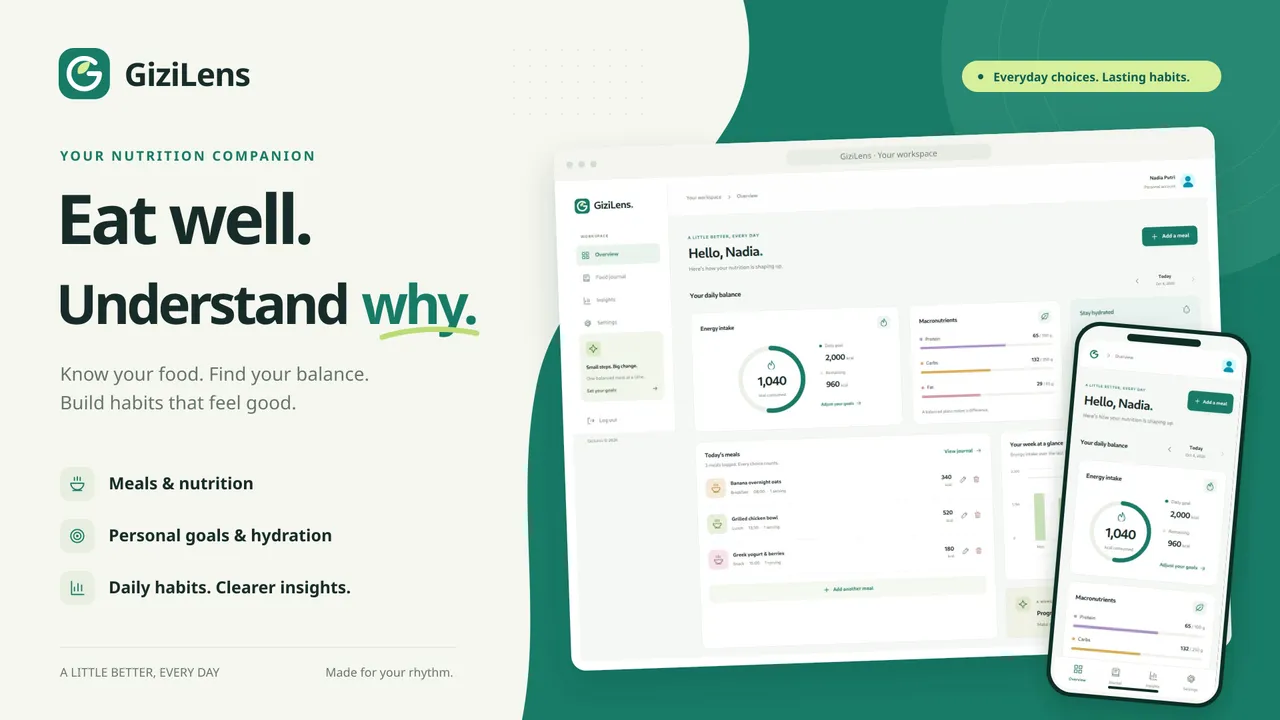
The current frontend is primarily an identity and account shell: registration, login, authenticated user information, token refresh, logout, and a dashboard. It does not currently expose a complete image-upload-to-classification user journey, so I avoid describing that intended integration as if it were already implemented.
Visual identity as a product system
The current GiziLens repository also contains visual-design work that I contributed within the capstone team and can point to directly rather than describing the interface only in technical terms.
I designed the original vector identity around three ideas already present in the product: the letter G, a circular lens or plate, and a leaf associated with food and wellbeing.
The identity includes a primary horizontal lockup, reverse and monochrome variants, a square icon, and a standalone symbol.
I also documented how that identity should behave in the application. The guidance covers a teal, lime, and ink palette, clear-space rules, a smaller icon treatment for constrained placements, and a reverse treatment for dark surfaces.
The frontend reuses the same geometry so the logo remains part of the product system instead of becoming a disconnected asset.
This was my visual-design contribution to a broader team product. It shows visual judgement without implying that I owned every part of the product interface or the machine-learning subsystem.
Authentication is a lifecycle, not one endpoint
A large part of my application contribution was making authentication more than a single login endpoint.
The backend exposes user registration for different roles, login, authenticated user retrieval and update, logout, account deletion/restore, and token refresh. JWT authentication protects authenticated routes, while persisted sessions give the application a server-side lifecycle for validating and revoking access.
sequenceDiagram
    participant U as User
    participant W as Nuxt app
    participant A as Hapi API
    participant S as Session layer
    participant D as PostgreSQL / Redis

    U->>W: Register or sign in
    W->>A: Submit credentials
    A->>D: Validate / persist user
    A->>S: Create session and tokens
    S-->>W: Return authenticated session

    U->>W: Open protected area
    W->>A: Authenticated request
    A->>S: Verify token and session
    S->>D: Resolve session / user state
    D-->>A: Current account state
    A-->>W: Protected response

    opt Access token needs renewal
        W->>A: Refresh session
        A->>S: Validate persisted session
        S-->>W: Issue refreshed access
    end
The frontend mirrors that lifecycle with auth composables, API proxy handlers, session-aware middleware, and client-side authentication state. That makes login, refresh, logout, and protected requests part of one flow rather than unrelated API calls.
Persistence stays behind application boundaries
PostgreSQL is used as the durable application store for users and sessions, while Redis provides a separate fast-access infrastructure boundary. The backend keeps these concerns behind repository and dependency layers instead of letting HTTP handlers talk directly to storage everywhere.
The server startup sequence reflects that separation: establish PostgreSQL and Redis connections, register the application's dependencies, build the Hapi server, register its plugins and authentication extensions, then start serving requests.
This structure was useful to me because it kept application rules, HTTP transport, and infrastructure from collapsing into one layer as my part of the project grew.
Running the web stack as a service
Frontend and backend have their own container build paths. The runtime configuration brings those services together with PostgreSQL, Redis, and Nginx on a shared Docker network.
Nginx configuration covers reverse-proxy concerns and HTTPS certificate setup, while the deployment scripts provide a repeatable way to build, update, and restart the GiziLens services.
This was the part of my capstone contribution where the web application stopped feeling like a collection of local files and started behaving like a small deployed system with clear service boundaries.
What I can directly attribute to my work
Within the team, my contribution to GiziLens centered on the Web-App and its runtime foundation.
I worked on the registration and authentication flow, JWT and persisted-session handling, user lifecycle APIs, PostgreSQL and Redis integration, the Nuxt-side authentication flow, and the containerized application setup around the frontend and backend. The repository also includes the Nginx, domain/HTTPS, build, and update configuration used to run those services together.
The current repository also contains the original GiziLens vector identity and its application rules described above. I treat that as my visual-design contribution to the team's product presentation, separate from the machine-learning subsystem maintained by another part of the team.
The machine-learning classifier remained an important team subsystem because it defined the product idea GiziLens was trying to support. The part I can directly attribute to my own repository history is the application and infrastructure around that idea, so that is the part I describe as my individual contribution here.
What the capstone clarified for me
GiziLens ended up teaching me more about system boundaries than about any single framework.
A model can solve the recognition problem. A backend can solve identity and persistence. A frontend can give people somewhere to interact with the system. Deployment can make those pieces reachable. None of those pieces becomes the whole product by itself.
The capstone made that separation concrete for me: understand what each subsystem is responsible for, be explicit about what has actually been integrated, and avoid treating a team project's combined output as one person's work.