

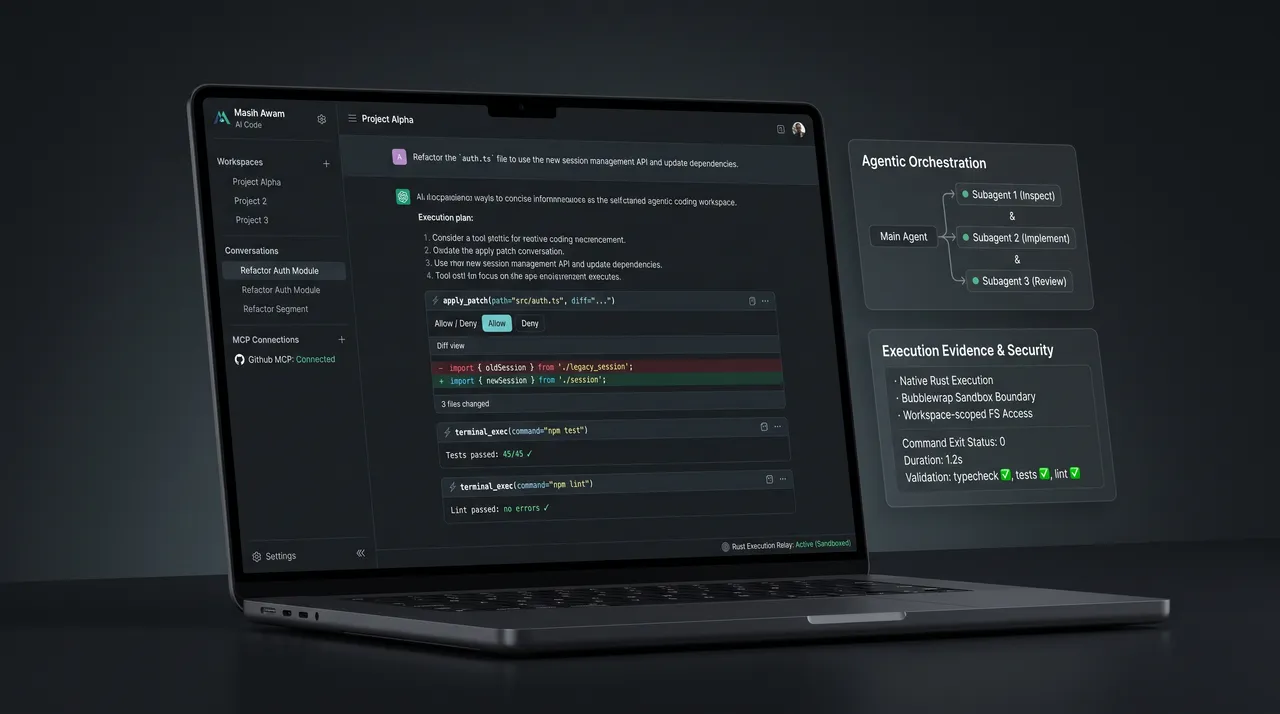
A coding agent has to work against real state
Most AI coding tools are very good at telling you what code should look like.
The problem starts when the task stops being local.
A real engineering task is rarely just “write this function.” It is usually closer to:
- inspect the repository;
- understand existing rules;
- find the real source of the bug;
- edit several files;
- run checks;
- read the failures;
- fix them;
- verify Git state;
- then explain what changed.
At that point, a chat assistant that only generates code becomes limited.
Masih Awam AI Code was built around a different question:
What would an AI coding assistant look like if it could actually work inside a real repository, but still had clear boundaries around what it is allowed to do?
Reasoning and authority are separate
The product separates reasoning from authority.
The AI can decide that a file should be edited or a command should be run, but it does not automatically own the machine.
Instead, every real action goes through a controlled execution path.
sequenceDiagram
    participant U as User
    participant A as Agent
    participant P as Policy
    participant E as Executor
    participant R as Repository
    U->>A: Describe the goal
    A->>P: Request a bounded capability
    P->>E: Allow approved action
    E->>R: Execute against real state
    R-->>E: Result
    E-->>A: Evidence
    A-->>U: Progress or completed result
That split is the most important concept in the application. It allows the agent to be useful without treating unrestricted shell access as the default trust model.
The user gives a goal, not a command script
The user gives the system a goal, not a sequence of commands.
For example:
“Find why this build fails and fix it.”
The system then tries to work the way an engineer would.
It inspects the repository, forms a hypothesis, checks the relevant files, makes a change, runs validation, and keeps going until the evidence supports the result.
The user sees the progress as work, not as hidden magic.
stateDiagram-v2
    [*] --> Observing
    Observing --> Deciding
    Deciding --> Acting
    Acting --> Verifying
    Verifying --> Deciding: more work needed
    Verifying --> Complete: goal satisfied
    Complete --> [*]
Observe, decide, act, verify
At a high level, the agent loop is simple:
observe
→ decide
→ act
→ verify
→ repeat
But each step matters.
Observe means reading actual repository state instead of guessing.
Decide means choosing the smallest useful next action.
Act means using a bounded capability.
Verify means checking whether the previous action actually improved the state.
Without verification, an agent is just an automated code generator.
Prefer narrow tools over unrestricted shell access
A terminal can do almost anything.
That is exactly why it is a poor default abstraction for every action.
If the system already knows the intent is “read a file,” “search the repository,” “edit a file,” or “inspect Git state,” then using a structured tool gives the system more context and creates better evidence.
The terminal remains useful for things that are genuinely command-oriented:
- builds;
- package managers;
- scripts;
- interpreters;
- project-specific tooling.
The philosophy is simple: use the narrowest capability that can solve the task.
Reconciling parallel agent work
Some tasks are easier to solve when they are decomposed.
One agent may research the problem while another prepares an implementation and another reviews the result.
flowchart TD
    P[Parent task] --> R[Research]
    P --> I[Implementation]
    P --> V[Review]
    R --> M[Reconcile evidence]
    I --> M
    V --> M
    M --> F[Final integrated result]
Spawning multiple agents is straightforward. The harder part is deciding how their work becomes one reliable result.
The parent must reconcile disagreements, reject weak evidence, and avoid merging competing changes blindly.
Interaction, orchestration, execution
The product has three conceptual zones.
flowchart TD
    X[Interaction] --> O[Orchestration]
    O --> E[Execution]
    E --> O
    O --> X
Interaction is where the user gives goals and reviews outcomes.
Orchestration decides how to break the task down and which tools to use.
Execution touches the real machine and therefore carries the strongest safety rules.
This separation keeps product logic away from native authority.
Evidence is part of the result
An AI saying “I fixed it” is not enough.
The system should be able to show what supports that claim:
- which files changed;
- what the diff looks like;
- which checks ran;
- whether tests passed;
- what Git state remains;
- which child tasks completed;
- which actions required approval.
That makes the assistant easier to trust because the result is attached to observable work.
Tradeoffs that shape the product
Freedom vs safety. A more powerful agent can solve more tasks, but every new capability expands the risk surface.
Automation vs control. Too many approvals make the experience tedious, but no approvals can make powerful actions dangerous.
Parallelism vs consistency. Multiple agents can move faster, but coordinating them introduces merge and reasoning complexity.
The product is built around managing those tradeoffs explicitly instead of hiding them.
Current implementation
The current system uses a web application for chat and orchestration, plus a native Rust execution relay for trusted machine operations. The main stack is Nuxt, Vue, Rust, MCP, PostgreSQL, Bubblewrap, OAuth/OIDC, and OpenTelemetry.